
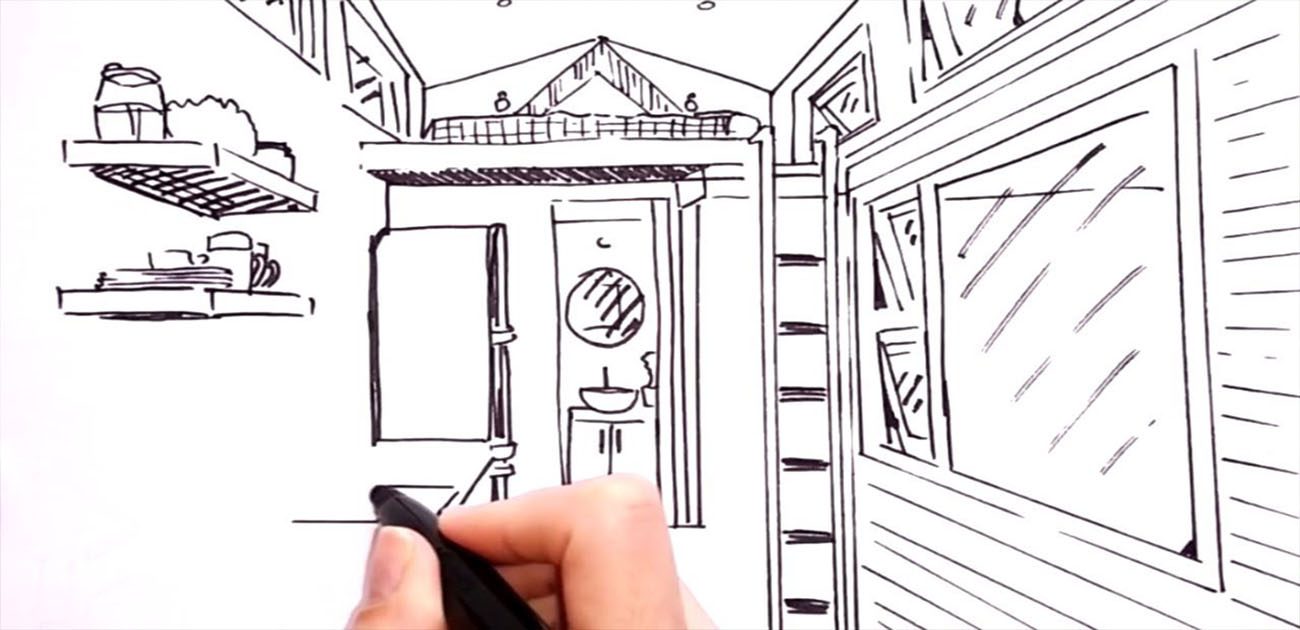
The Design
There is nothing more creative and annoying than designing your own Tiny house.
Creative because small spaces make you think about how to fit everything inside it and make the best use of space. It makes you analyze what you need and don’t need in your daily life. To de-clutter and live smaller. There are so many amazing ideas and space saving designs to inspire you with your own project.
Annoying because there are so many amazing ideas and space saving designs to inspire you. It is endless. We must have designed and redesigned the Tiny House more than 100 times. I probably have 70 drawings of different tiny house layouts, different sizes, 2 story & 1 story adaptions. fold-outs, slide-outs, attached decks, designs that join together to form a larger house.

After we ‘settled’ on a design and built the 3D model, I still made tweaks and adaptions fighting with myself over what’s best for months. I kept all of the paper sketches which helped a lot at this stage. As I could look back over them and analyze why I never settled on that design.
Things to think about when designing:
On a trailer or demountable building? You will need to check council regulations for your local area about the legality of living in a tiny house. Laws vary from country to country and even state to state. In New Zealand, each council had different laws and several lawsuits were filed around the country from tiny house owners fighting the councils. Councils were arguing that despite the tiny house having wheels, it is for permanent living and thus, classified as a building and should be subject to all council conditions and building regulations. Tiny owners understandably argued that a tiny house is classified as a vehicle as its on wheels and thus temporary living. In the end, salvation came in the name of a national law, which allowed buildings under 30sqm to be built without any council permission and permit. Solving the issue and allowing Tiny houses whether they are “permanent” or “temporary” living. We chose a trailer mounted tiny house, as it is just easier to build on, move and relocate.
Is your tiny house going to be stationary or moved a lot? This will affect the size you should build it. Country road codes will dictate the maximum dimensions something can be to be allowed on the road. As an example, in New Zealand, a trailer can not be more than 12.5m long (41ft), 4.3m high (14ft), 2.55m wide (8.3ft). Anything larger than this requires special permissions to transport and the use of pilot vehicles and trucks to move.
How many people will be living in it? Do you need multiple beds? separate spaces? an office area?
Off-grid or on-grid? This will massively affect your costs. To run an entire tiny house off-grid has a lot of additional costs and materials. Such as solar panels, batteries, water tanks/collection, and waste water tanks/collection. You also need to consider rubbish collection.
Our final design:
Our tiny house is designed to be completely off grid. We settled on a trailer base, so this design will be built on top of a trailer. Meaning we could build it off site and tow it to to a rented property. It also allows us to move it again when we finally purchase property. (New Zealand property prices are horrendous).


We live in a cold climate, meaning all windows and doors had to be double glazed. We also purchased (rather cheaply) an amazing amount of insulation to insulate the floor, walls, and ceiling.
We opted for a 2-story tiny house, having a mezzanine floor above the kitchen/bathroom area which is the bedroom location. Being quite tall, I decided to only add a single second story so that there is plenty of head room above the lounge area. We also included two small office areas in between the bathroom and kitchen. This just allows us a separate space should we need it. Its always nice to have a desk.
Our tiny house is designed to be completely off grid. I’ll follow up how we are doing this in another post. Over all, the size of our tiny house is: 2.5 meters wide (8.2ft) x 7 meters long (23ft) x 4.2m high (13.7ft). Plus the trailer drawbar.
Stay tuned folks.